Your customers used to type a few keywords into Google. Now many of them ask a question instead, and they ask it in more than one place: Google’s AI Overviews, ChatGPT, Claude, Perplexity, Gemini or Copilot. If those tools don’t know your business, or can’t find a clear answer on your site, they recommend someone else.
That’s what AI visibility means: whether search engines, answer engines and AI engines can find, understand and recommend your business.
What is the difference between SEO, AEO and GEO?
They’re three layers of the same goal:
- SEO (search engine optimization) gets your pages ranked in traditional search. It’s still the foundation, because AI tools often draw on pages that already rank.
- AEO (answer engine optimization) makes your content easy to quote. Featured snippets and AI Overviews lift one short, clear passage, and AEO makes sure it’s yours.
- GEO (generative engine optimization) helps AI models understand who you are, what you do and why to trust you, so they can recommend you by name.
How can you tell if AI can find your business?
Start with a simple test. Ask two or three AI assistants the questions your customers ask, such as “who’s a good [your service] provider in [your area]?” or “how much does [your service] cost?” Note whether you’re mentioned, whether the details are right, and which sources they cite.
Then check your site for the basics AI depends on.
What are the quick wins for AI visibility?
- Answer questions directly. Use headings phrased as real customer questions, and answer each one in the first 40 to 60 words beneath it.
- Add FAQs where buyers have questions, and mark them up with FAQ schema.
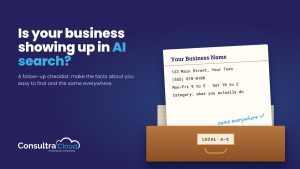
- Make your identity unmistakable. Use the same business name, description and contact details everywhere, with clear About and service pages.
- Don’t block AI crawlers by accident. Check your robots.txt and security settings.
- Publish an llms.txt file, a short guide that tells AI crawlers what your site is about and where the important pages are.
- Keep content fresh and attributed. Date your claims, show who wrote it and update pages that have gone stale.
How do you write an answer AI will quote?
AI tools and featured snippets look for a short, self-contained answer directly under a clear question. Compare these two:
- Hard to quote: “At our firm, we’ve been helping clients for years, and pricing can depend on many factors, which we’re always happy to discuss on a call.”
- Easy to quote: “Managed IT for a small office is usually priced per user per month. The price depends on the number of users, the support hours included and the security tools in the plan.”
The second version answers the question in the first sentence, uses plain words and stands on its own. Write the answer first, then add detail below it.
Do you have to replace your SEO plugin?
No. Tools like Rank Math and Yoast are editors: they manage your titles, sitemaps and schema while you write. You still need them. What they don’t do is audit the whole site for answer-engine and AI readiness and tell you what to fix first.
Ready for the next step? Our AI search visibility checklist turns this into a working list you can finish in an afternoon and repeat each month.
Frequently asked questions
Is SEO dead because of AI?
No. Search didn’t die; it multiplied. Strong SEO is still the base that AEO and GEO build on.
What is llms.txt?
A plain text file at the root of your site that gives AI crawlers a short, structured summary of your business and links to your key pages.
How long does it take to improve AI visibility?
Technical fixes, like unblocking crawlers or adding llms.txt, can be done in a day. Content changes build up over weeks as engines re-crawl your site.
Find out what AI thinks of your website
MyAuthorityIQ is a WordPress plugin that audits every page of your site for SEO, AEO and GEO, scores each one and gives you a prioritized fix list with suggested copy. It works alongside Rank Math and Yoast, not instead of them. Start with the free version to see where you stand.