A customer feedback survey people actually answer is short, asks one main question, arrives right after a real interaction, and shows customers that their answers changed something. Get those four right before you reach for a discount or prize draw.
Below: a three-question template, when to send it, and what to do with the answers.
1. Decide what you want to learn first
Most surveys fail before they’re written. Someone says “let’s survey customers” and the questions pile up: satisfaction, pricing, features, staff, website, referrals. Long, unfocused surveys are the ones people quit halfway through.
Start by finishing this sentence: “After this survey, we will decide ____.” If you can’t name a decision, you don’t need a survey yet. Good examples:
- Which of three new services to offer first
- Whether the new onboarding process is working
- What’s stopping trial users from buying
2. Keep it short, with one main question
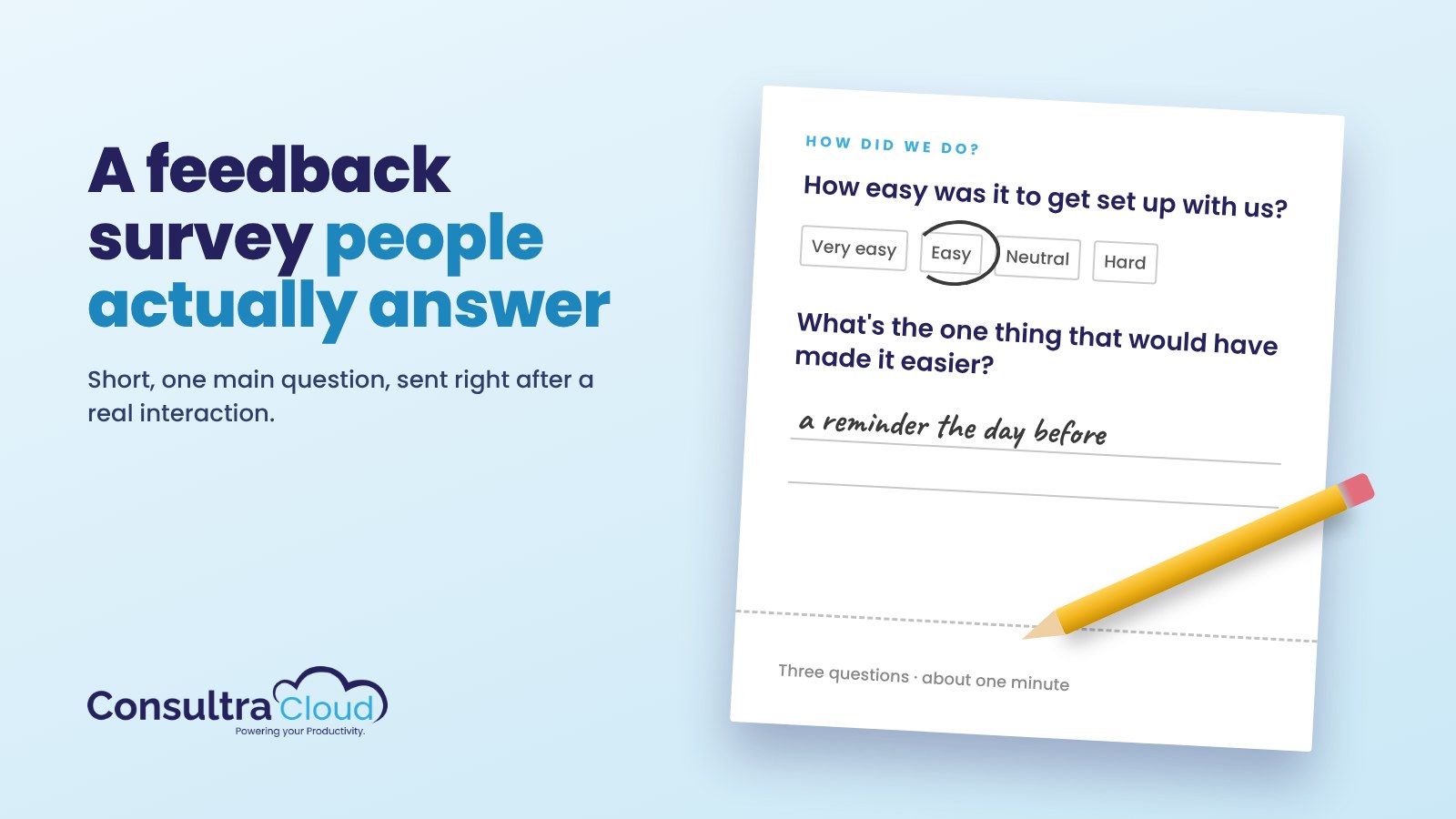
Build the survey around a single main question tied to that decision, then add no more than two follow-ups. A template you can copy:
- Main question (closed): “How easy was it to get set up with us?” Very easy / Easy / Neutral / Hard / Very hard
- Follow-up (open): “What’s the one thing that would have made it easier?”
- Optional: “Can we contact you about your answer?” Yes / No
Three questions, under a minute to complete. Tell people that up front: “Three questions, about one minute.” An honest time estimate makes it easier to say yes.
Question-writing rules
- One idea per question. “How satisfied are you with our speed and quality?” is two questions. Split it or pick one.
- Neutral wording. “How much did you love our new portal?” pushes people toward a happy answer. “How would you rate the new portal?” doesn’t.
- Plain words. Use the words your customers use, not your internal product names or jargon.
- Balanced scales. Give as many negative options as positive ones, with a neutral middle.
- Make open questions optional. Required essay boxes are where people give up.
3. Get the timing right
Ask while the experience is fresh. The best moments are tied to something the customer just did:
- A day or two after a purchase, delivery or completed project
- Right after a support request is resolved
- A week or two after someone starts using a new product or feature
- Shortly before a renewal, while there’s still time to fix a problem
Avoid blasting the whole customer list with the same survey on the same day. It’s harder to interpret, because people are reacting to very different experiences, and it trains customers to ignore your emails. Set a simple rule, such as no customer gets more than one survey a quarter.
4. Close the loop
It’s the easiest step to skip, and it’s what makes the next survey work. Closing the loop means telling people what happened because of their answers.
- Thank people right away. A short confirmation that says what happens next.
- Follow up on low scores personally. If someone said setup was “very hard” and agreed to be contacted, call or email within a few days. You’ll learn more from that conversation than from the whole spreadsheet.
- Share what you changed. A short “You told us, we did” note in your newsletter, on your website or in the app. Even one change is worth announcing.
- Be honest about what you won’t do. “Several of you asked for weekend hours. We can’t staff that yet, but we’ve extended weekday hours to 7pm.” People respect a clear answer more than silence.
Customers who see their feedback lead to a change are more likely to answer next time. Customers who hear nothing learn that surveys are a waste of their time.
5. Turn the answers into a roadmap
Survey answers are only useful if they feed into decisions. A simple process:
- Read every open answer. For small volumes, a person reading beats any automated summary.
- Tag each answer with a short theme, such as “setup instructions,” “billing,” or “mobile.”
- Count the themes and note how strongly people felt.
- Score the top themes on demand, fit with your best customers, effort and impact.
- Pick one or two to act on this quarter, and tell customers which ones.
For product feedback in particular, a survey is a snapshot. Requests and ideas keep arriving between surveys, by email, chat and phone. Our guide on how to turn customer feedback into a product roadmap covers how to keep that ongoing flow organized and prioritized.
A one-page customer feedback survey checklist
- We can name the decision this survey will inform.
- One main question, no more than two follow-ups.
- We tell people how long it takes, and it’s true.
- Wording is neutral, plain and one idea per question.
- It’s sent right after a real interaction, not as a blast.
- Low scores get a personal follow-up.
- We’ll share at least one change that came from the answers.
If you’re weighing whether to add yet another tool for this, our post on focused tools vs all-in-one software offers a simple way to decide.
Keep feedback in one place between surveys
If most of your feedback is about a software product or app, MyAppFeedback gives feature requests, bug reports and ideas a single home. Users upvote what they want most, you move items from planned to shipped, and users see the status change, which helps you close the loop. There’s a free plan with one board if you want to try it.
Frequently asked questions
How many questions should a customer feedback survey have?
For most small businesses, one main question plus no more than two follow-ups. Short surveys are easier to start and finish, and the answers are easier to act on.
When is the best time to send a customer feedback survey?
Right after a real interaction, while it’s fresh: a day or two after a purchase or completed project, right after a support request is closed, or shortly after someone starts using a new product.
Should I offer an incentive for completing a survey?
It isn’t necessary for most small businesses. A short survey, an honest time estimate and visible follow-through usually do more. If you sell on platforms with review rules, check them before offering anything in exchange for feedback.
What does closing the loop mean?
Closing the loop means telling customers what happened because of their feedback: thanking them, following up on problems, and sharing the changes you made or the reasons you didn’t.
What’s the difference between a survey and a feedback board?
A survey asks a set question at a set time and gives you a snapshot. A feedback board collects requests and ideas continuously, so you can see what customers want most at any point.
This article is general information for small businesses, not legal or professional advice.